


Péter Szijjártó, Hungary’s minister of foreign affairs and trade, was in Szeged on Friday not only for the inauguration of the Rheinmetall factory. The minister also attended the cornerstone-laying ceremony for Metrans’ new rail terminal at Szeged City Hall, where he tightened a rail bolt alongside Mayor László Botka and Béla Mihálffy, a Christian Democratic member of Parliament.
Speaking at the ceremony, Mr. Szijjártó said the German-backed company would build one of Europe’s most modern rail–road terminals in the city by 2027. The new terminal will also be extremely important for providing logistics services to the BYD factory and will open a new gateway for the economy of the Southern Great Plain region, as European ports will be directly accessible from here.
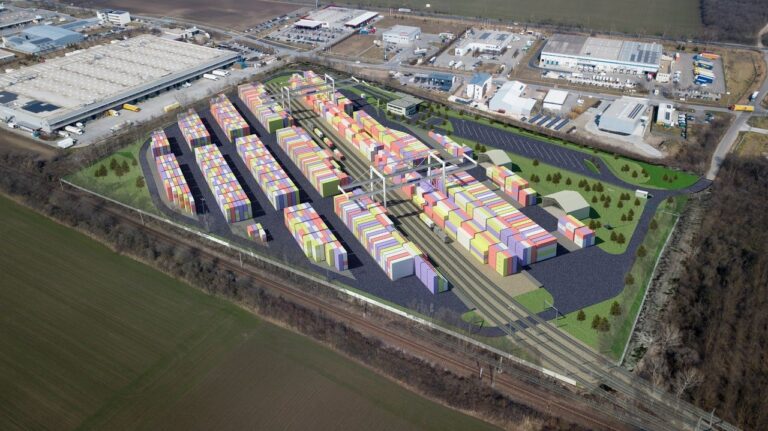
The terminal will be built on a nearly 10-hectare site in Kiskundorozsma, near the wholesale market. Among other features, it will include four loading tracks, each 330 meters long, and two remotely controlled, high-tech electric gantry cranes to handle cargo. The facility will be capable of receiving and dispatching six pairs of trains per day and handling up to 300,000 TEUs of containers annually.
Beyond meeting existing logistics needs, the terminal is expected to attract new investments to the region by offering efficient rail and road connections—particularly in manufacturing, the automotive industry, electronics, fast-moving consumer goods, and e-commerce.
In a statement, Metrans also noted that the terminal development will help reduce road congestion, easing traffic loads along the M5–M43–Route 55 road corridor and in surrounding settlements. The investment will create new jobs and generate additional supplier partnerships.
The company said it would also protect the environment by using the most advanced technologies. The terminal will connect Szeged with major European destinations, making low-emission transport more easily accessible for businesses in the region.
In his speech, Mr. Botka offered special thanks to the company’s parent organization, the Port of Hamburg, for what he called a decision that “represents not only economic but also strategic trust in us.” According to the mayor, the fact that another global company has chosen the city is “a clear confirmation that Szeged is on the right path.”
It is not new that Metrans is building a new rail terminal in Szeged; the plan was announced several years ago, in 2022. At the time, the news surprised not only industry professionals but also residents of Szeged, as BYD’s factory was not yet on the horizon.
The investment was initially planned for completion by 2025, but it later emerged that the logistics needs arising from the subsequently announced Chinese car factory project would be met not by building a second rail terminal, but by merging the two at the Metrans site. As a result, the start of construction was ultimately delayed, as the facility was redesigned and the original two tracks were expanded to four—an issue that was also raised with János Lázár during his visit to Szeged last year.
The Metrans Group is one of Europe’s leading rail logistics service providers and is a subsidiary of the German company HHLA (Hamburger Hafen und Logistik AG), specializing in intermodal container transport. Its core activity is the rail transport and distribution of containerized goods between seaports and inland regions across Europe.
Metrans currently operates a network of 20 inland container terminals in 13 countries, which are connected daily by rail to each other and to major ports on the Adriatic and North Seas. The Metrans Group also has its own railway company, runs 650 container trains per week, and employs nearly 3,000 people across Europe.